
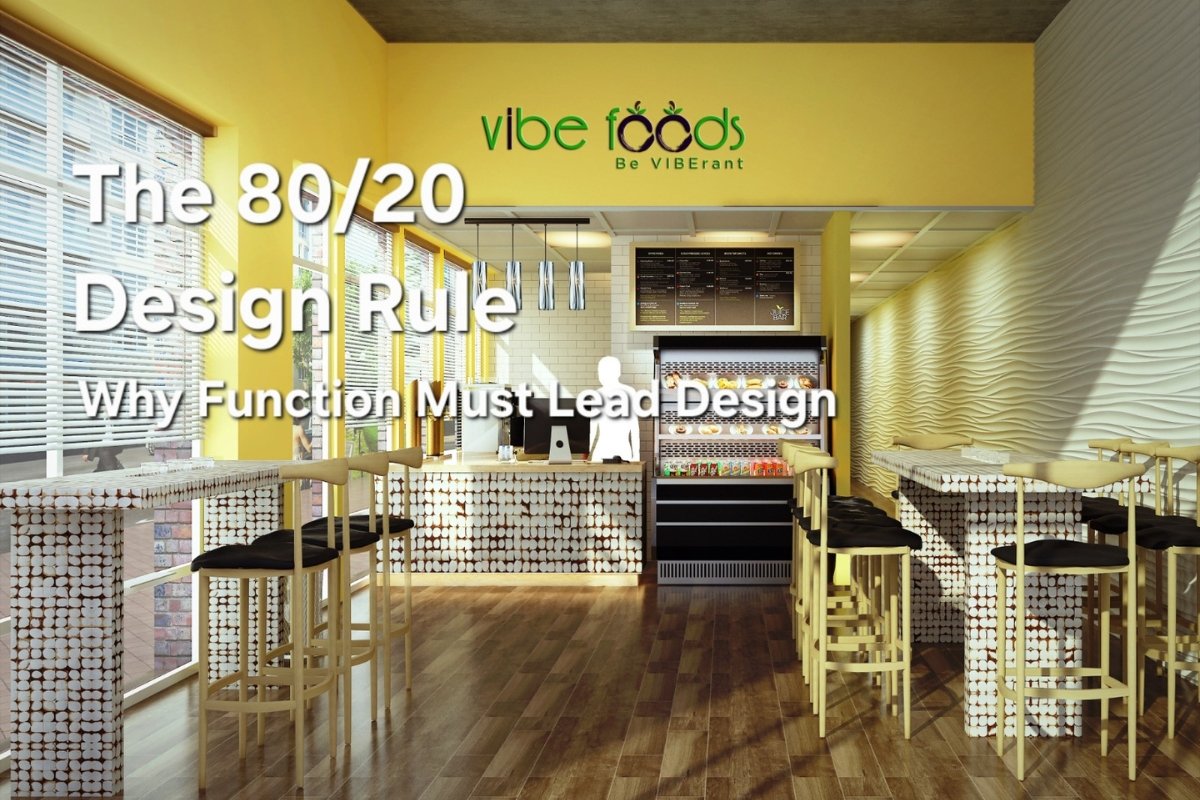
The 80/20 Design Rule: Why the Future of Interior Design Depends on Rebalancing Form and Function
Most of what the world calls “design” today is simply decoration—algorithm-driven aesthetics, pretty pictures, quick inspiration, and visual noise circulating endlessly through social media. Much of it is created by content and template creators rather than design professionals.
And in the process, one essential truth has quietly slipped out of public consciousness:
Design is not an image.
Design is an ecosystem.
Increasingly, the industry is confronting a question that has shaped architecture for more than a century:
What happens when beauty is prioritized before function?
The answer, as history has shown us, is inefficiency disguised as design.
To understand how we arrived here—and how to course-correct—we must revisit the philosophies of two architectural giants whose work continues to define modern functionalism.
Louis Sullivan gave us the principle “Form follows Function,” meaning design should serve the purpose of the building before ornamentation.
Frank Lloyd Wright evolved the idea into “Form and Function are One,” forming the foundation of organic architecture—a holistic approach where site, structure, furniture, and nature exist in harmony.
From their collective legacy emerges a modern principle reshaping interior design and construction today:
The 80/20 Design Rule
Eighty percent of a project’s design energy must be invested in function, logic, performance, and efficiency, while twenty percent is reserved for aesthetic expression.
This recalibration restores integrity, longevity, and intelligence to the built environment.
A Shift in Thinking: Why Function Must Lead Again
For decades, the interior design process has quietly drifted toward visual gratification. Digital platforms reward quick beauty. Clients fall in love with mood boards. Emerging designers feel pressured to produce “wow” moments before understanding the bones of a space.
This is where most aspiring designers fail.
Function is not glamorous.
It’s not Instagrammable.
But it is where your expertise, confidence, and professional value are formed.
Before the aesthetics.
Before the finishes.
Before the Pinterest board…
You must master the functional foundation.
That foundational 80% includes:
- how people move through the space
- spatial hierarchy
- activity zoning
- structural alignment
- electrical and plumbing considerations
- lighting strategy
- long-term maintenance
- ergonomics and comfort
- acoustics
- sustainability and lifespan
This is the anatomy of real design.
The backbone. The infrastructure. The invisible intelligence that makes a space feel effortless.
And in my experience, this is the part most design professionals ignore.
Why Function Matters: Two Real Examples Designers Need to Hear
Example 1 — Restaurant Kitchens That Look Beautiful but Don’t Work
As a restaurant design specialist, I’ve heard the same complaint countless times from restaurant owners and chefs:
“The architect designed a beautiful kitchen… but it doesn’t work.”
Beautiful? Yes.
Functional? No.
Cost-effective? Absolutely not.
A poorly planned kitchen forces chefs to take 50, 70, even 100 unnecessary steps per hour—every shift. Multiply that over a year and you create:
- fatigue
- inefficiency
- wasted payroll
- slower service
- higher operating costs
That is not design.
That is dysfunction disguised as beauty.
Example 2 — Angled Walls That Serve No Purpose
Architects and designers often add angled walls to “create interest.”
In museums, galleries, or monumental spaces—where geometry has intention—this can be powerful.
But in everyday environments?
Angled walls:
- waste square footage
- complicate furniture layouts
- disrupt circulation
- increase construction costs
- create awkward dead corners
- and force homeowners to live with poor design for decades
If a space doesn’t have the luxury or purpose for sculptural geometry, adding it isn’t creativity—
it’s inefficiency dressed up as design.
This is exactly what the 80/20 rule protects you from.
When the functional 80% is thoughtfully resolved, the aesthetic layer becomes intuitive rather than forced—an extension of logic rather than an attempt to conceal flaws.
The 20% Aesthetic: The Poetry Layer of Design
Once the functional framework is complete, the aesthetic layer becomes effortless, intentional, and emotionally resonant.
This is where artistry unfolds through:
- materiality
- texture
- light and shadow
- color psychology
- visual rhythm
- contrast and harmony
- proportion and balance
When the 80% is solved, beauty emerges naturally.
Aesthetics are no longer imposed—they are a response.
This is why Wright’s spaces still feel timeless.
The beauty wasn’t applied.
It was revealed.
Why This Matters Now
As the industry leans into AI, rapid rendering, generative visualization, and instant design concepts, the greatest risk we face is mistaking visual accuracy for design intelligence.
Fast design mirrors fast food—produced at speed, consumed in moments, and often leaving you with that unmistakable “something’s not quite right” feeling afterward.
But design built on intention—design born from function—becomes timeless, enduring, and sustainably rooted.
AI itself is not the problem. Used wisely, it is one of the most powerful creative tools of our time. AI excels at repetitive, time-consuming tasks: generating concept iterations, cleaning drawings, enhancing presentations, streamlining documentation, analyzing spatial data, and accelerating early visualization.
These efficiencies don’t replace designers—they amplify them.
By letting AI handle mechanical workload, designers reclaim their most precious resource: creative energy—energy that can be reinvested into conceptual thinking, spatial problem-solving, material exploration, and the deeper functional questions no algorithm can answer.
In this new era, the leaders who will define the next decade understand one distinction clearly:
AI can assist with form, but only a designer can give it purpose.
A Return to Design That Endures
At its core, the 80/20 Design Rule is a modern manifesto—a call to return to intentional architecture and human-centered design.
It reminds us that:
- A beautiful home that doesn’t function eventually fails.
- A functional home, thoughtfully designed, quietly transforms lives.
This is the kind of design that endures.
Not for a season.
Not for a trend cycle.
But for generations.
Want to Explore the 80/20 Rule in Professional Practice?
Designers, decorators, architects, trades, and builders who want to implement this principle at a mastery level can dive deeper inside my Interior Design & Construction Masterclass.
👉 To learn more, book a free strategy call here
Because when design is built on purpose, beauty becomes inevitable—and the work becomes timeless.


About author



Add comment