
For decades, the design thesis has served as a ceremonial capstone in architecture and interior design education—a final intellectual proving ground before students enter professional life. Traditionally, it has been framed as a theoretical exercise: an opportunity to explore ideas, experiment freely, and contribute conceptually to the discipline.
Yet as the design industry evolves—under the pressures of climate responsibility, accelerated construction timelines, and increasingly sophisticated clients—the question arises: Is the traditional design thesis still preparing designers for the world they are about to enter?
Increasingly, the answer is no.
The Traditional Thesis: Intellectually Rigorous, Professionally Incomplete
Most design schools continue to structure the thesis around a familiar academic framework:
Students select a topic of interest, often tied to social or cultural issues.
They conduct extensive research, analyzing precedents and theories.
They develop a design proposal through drawings, models, and renderings.
They aim to contribute an original idea—conceptual, speculative, or symbolic.
This model has undeniable academic merit. It encourages critical thinking, visual exploration, and intellectual independence.
What it does not always encourage is accountability.
Too often, the thesis remains detached from the realities that define professional practice: budgets, systems, durability, environmental impact, and the lived experience of occupants over time. Graduates emerge inspired—but uncertain how to translate theory into leadership.
A Contemporary Shift: From Conceptual Exploration to Design Responsibility
Design today demands more than expressive ideas. It requires judgment.
In professional practice, designers are not only creators; they are decision-makers whose choices affect resources, labor, and lives. A contemporary design thesis must therefore do more than speculate—it must reason.
A new framework is quietly emerging, one grounded not in abstraction, but in synthesis. At its core are three interdependent hypotheses:
Function. Form. Sustainability.
Together, they redefine the thesis as a real-world design intelligence exercise.
Function Hypothesis: Defining Purpose Before Expression
At the foundation of every successful project lies a simple, often overlooked question:
What is this space meant to do—and for whom?
The Function Hypothesis demands that designers begin not with aesthetics, but with purpose. It asks them to study human behavior, operational needs, spatial performance, and daily use patterns. It reframes design as a response to real conditions rather than an act of personal expression.
This shift is subtle but profound. When function is clearly defined, design decisions gain authority. Constraints become tools. Creativity becomes focused rather than performative.
It is here that decorators begin to think like designers—and designers begin to think like leaders.
Form Hypothesis: Aesthetic as Intentional Communication
If function defines the problem, form articulates the response.
In this framework, aesthetics are not stylistic indulgences or trend-driven gestures. They are deliberate expressions of intent. Proportion, materiality, spatial hierarchy, and visual rhythm become part of a coherent narrative—one that communicates purpose as much as beauty.
Form, in this sense, is not decoration. It is meaning made visible.
The result is work that feels grounded rather than contrived, timeless rather than topical. Spaces that resonate not because they follow trends, but because they feel inevitable.
Sustainability Hypothesis: Designing for Longevity, Not Just the Present
No contemporary design education can ignore sustainability—but the most effective approaches move beyond checklists and certifications.
The Sustainability Hypothesis asks designers to consider longevity as a design value. How will materials age? How easily can spaces adapt? What resources are consumed, and which are preserved?
Sustainability here is not a visual identity or a marketing label. It is a measure of design maturity—an understanding that good design minimizes waste, maximizes lifespan, and respects both environment and occupant. In this sense, sustainability is not separate from form and function. It is the lens through which both are evaluated.
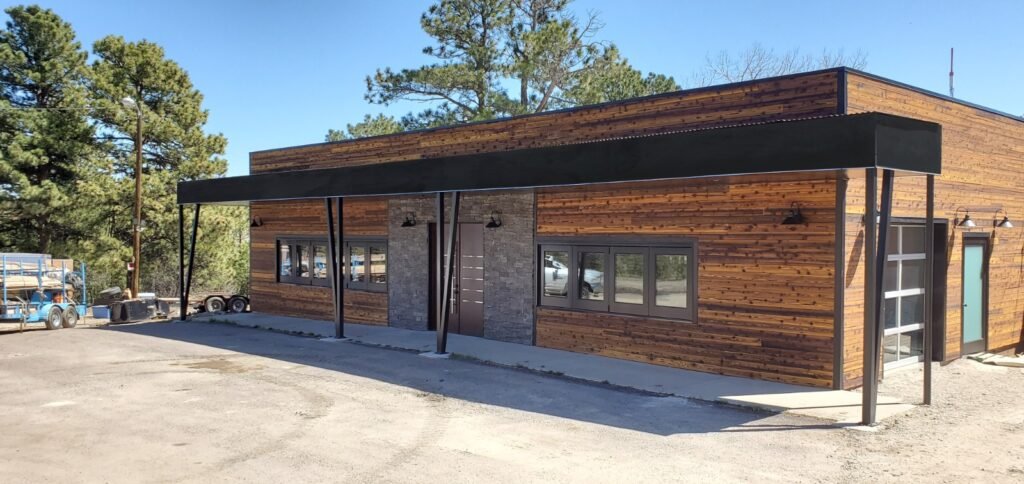
The catering facility is clad in organic Japanese Shou Sugi Ban wood siding—an ancient charring technique that produces a richly textured surface celebrated for its durability, low maintenance, and enduring beauty over decades.
The Thesis as a Professional Threshold
When structured around Function, Form, and Sustainability, the design thesis becomes something else entirely: a rehearsal for professional life.
It trains designers to articulate decisions, coordinate systems, anticipate constraints, and present ideas with clarity and confidence. It produces not speculative imagery, but client-ready thinking.
Perhaps most importantly, it marks an identity shift. The designer no longer asks, “What do I want to express?” but rather, “What is required here—and how can I solve it intelligently?”
That question defines professional credibility.
A New Standard for the Next Generation
As design disciplines confront the realities of climate change, economic pressure, and cultural complexity, education must evolve accordingly. The most relevant theses of the future will not be those that shout the loudest, but those that hold up under scrutiny.
Design is no longer about visual impact alone.
It is about performance, responsibility, and coherence.
A contemporary thesis—grounded in function, articulated through form, and guided by sustainability—offers a blueprint not just for better projects, but for better designers.
And that may be the most meaningful contribution design education can make today.
Design education is at a crossroads.
The question is no longer what looks compelling—but what works, lasts, and serves.
This practical program is intentionally designed for real-world implementation, not the purely theoretical design thesis model taught in most traditional design schools.
If you are a designer ready to branch out independently—or a decorator prepared to step into the role of a professional designer—this program was created for you. Book a free strategy call here.






Add comment